Journal
One day, one record.
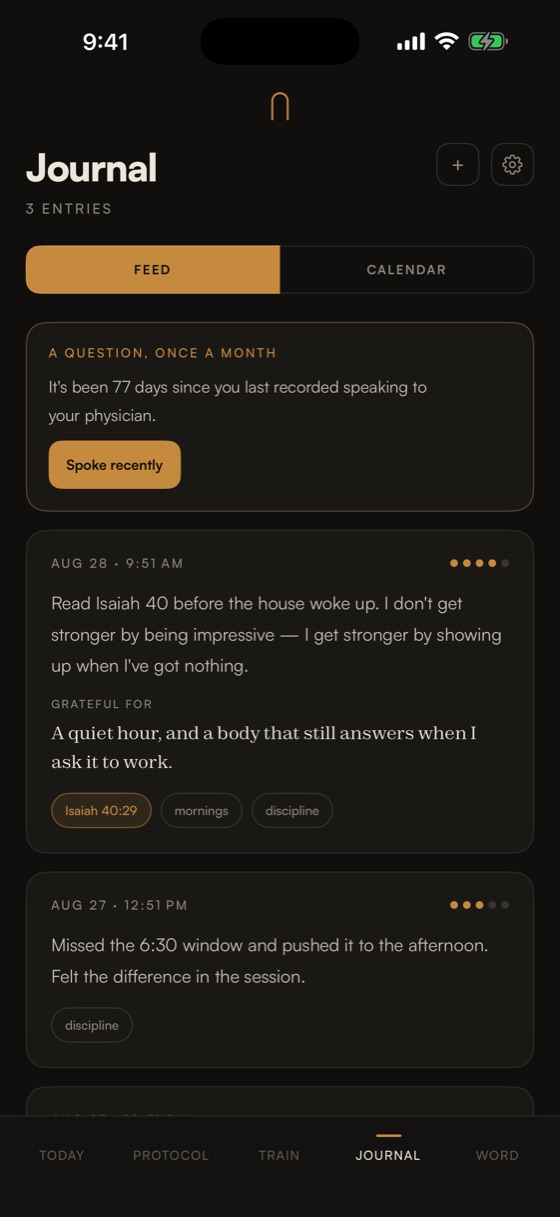
Mood, gratitude and entries that link back to the verse, the session or the dose behind them.
Why the links matter more than the writing
A standalone journal answers “how did I feel?” A linked one answers “how did I feel, on the day I did that.” The second question is the useful one, and it is unanswerable if the training log, the protocol record and the diary live in three different places.
This is the same argument the whole app rests on, applied to the end of the day rather than the start of it. The verse, the session and the dose share a page because they shared a day.
What it is
By evening the day is already mostly written down. The passage is recorded, the session is logged, the dose carries the time it was taken. The journal is where you say what all of that was actually like.
An entry is short on purpose: a few lines, a mood, and something the day was worth. What makes it useful is not the writing but what it is attached to: the entry knows which passage you read that morning and which session you trained that afternoon, so a day opens as one page instead of four.
It can be locked, and the lock re-arms every time you put the phone down.
Two decisions worth explaining
The lock re-arms on background
A journal lock that stays open once you have unlocked it protects nothing. You unlock it in the morning and it is open for the rest of the day, including when you hand your phone to someone to look at a photograph. So the lock re-arms every time the app goes to the background.
It is very slightly more annoying, and it is the only version of the feature that is actually a lock.
The physician card asks, and records the answer
Once a month the journal asks when you last spoke to your physician about what you are tracking, and writes down what you said. It is a prompt rather than a requirement. It can be dismissed, and it never blocks anything.
It exists because the honest failure mode of a good self-tracking tool is that it makes the doctor feel redundant. This one is built to point the other way.
The other three