Train
The last numbers you hit, held where you can see them.
Your programs and your movements, with every decision aimed at one thing: getting the phone out of the way between sets.
254 exercises, every one illustrated
Every movement in the library is drawn twice, once at the start of the rep and once at the finish, so the exercise can be seen rather than inferred from a name. Tap a picture for it full size.
Finding one does not require knowing what it is called. Point at the part of the body it works, or describe it in your own words and let the search sort it out. Naming a movement correctly is a thing you learn from training, not a thing you should need before you can start.
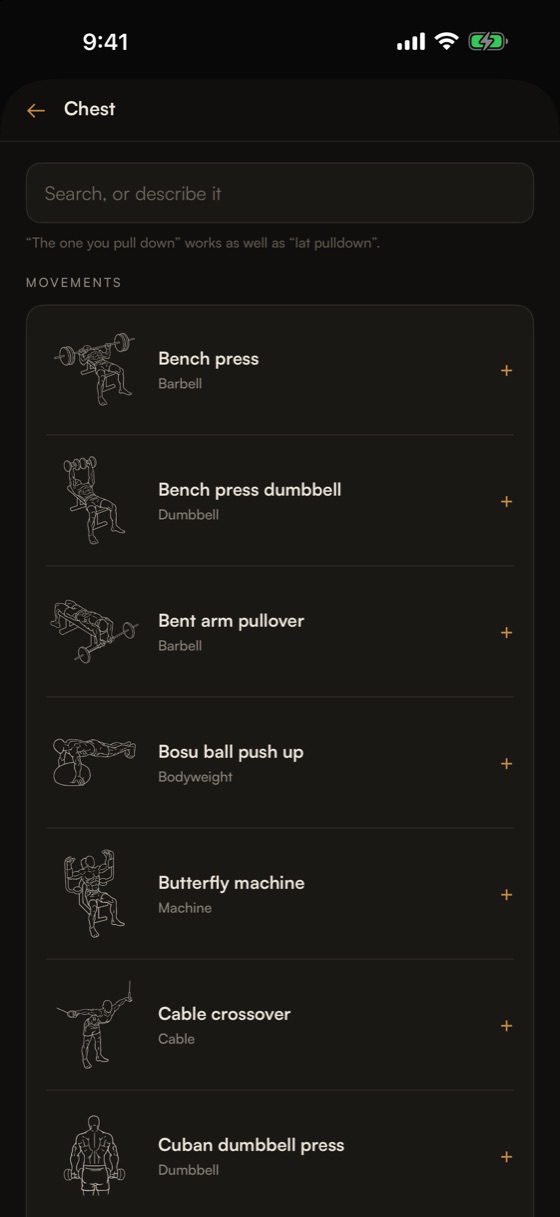
The drawings are from the Everkinetic set, published under CC BY-SA 3.0 by way of Wikimedia Commons, recoloured to sit in the app's palette. They were not drawn for TEMPLE, and saying otherwise would be a claim we cannot support.
What it is
Before a session it is a list: the day's movements, in order, with what you are meant to hit. Afterwards it is history. What happens in between is the part the whole pillar is designed around, and in between it asks almost nothing of you.
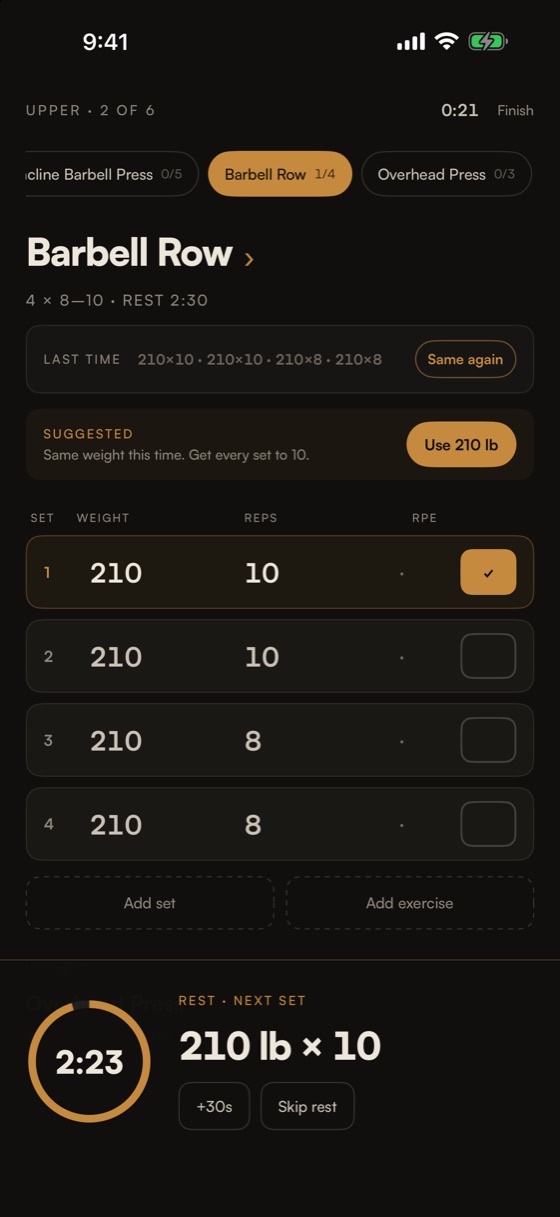
You mark a set done. The rest timer takes over on its own and starts counting on your wrist. What you lifted last time sits behind the target the entire while, so the number you are chasing is never something you have to stop and look up. The phone can then go back in your pocket, locked, and the next set is logged from the lock screen.
The effect is that a session produces a complete record without ever having been a thing you were doing between sets.
Why every decision here is about the phone getting out of the way
Mid-set, the phone is a liability. You have thirty to ninety seconds, chalk or sweat on your hands, and a bar to get back under. Any app that asks you to navigate during that window will lose. You will stop logging, or you will stop resting properly, and either way the record becomes fiction.
So the design target was never “more features per screen.” It was: how few seconds of attention can a logged set cost? Ghosted history, the automatic timer, the wrist countdown and lock-screen logging are four answers to that one question.
The last numbers, held where you can see them
The single most common thing a lifter needs mid-set is what they did last time. Most apps put it one tap away in a history sheet. One tap is too many, so it sits ghosted behind the target instead: always visible, never in the way.
The whole session, one thumb
Once a session is running it is a Live Activity. The phone can stay locked in your pocket for the entire workout while sets are logged from the lock screen, and the watch handles the rest countdown on your wrist so you are not looking at a screen at all between sets.
Two decisions worth explaining
It runs beside Apple's Workout app, not against it
The Apple Watch already measures heart rate, energy and distance better than a third-party app is going to. TEMPLE does not try to replace that. It records what you lifted, the thing Apple does not capture, and matches the session to the Health workout recorded over the same window, so one day has one record rather than two competing ones.
The estimate is Epley, and it says so
Estimated one-rep max uses the Epley formula on your best working set. It is an estimate, it is stated as an estimate, and the arithmetic is one line you could do on paper. There is no proprietary score, no readiness index, and no number in the app whose derivation is hidden from you.
A metric you cannot check is a metric you have to take on faith. This app asks for as little faith as possible.
The other three